
JSW Steel: Salem Plant


JSW Steel: Salem Plant
Project AI Research Agent
Project Story
We are seeking €640,000 to build a 500kWth initial project for JSW including a 2 concentrator implementation.
10% Hot Water Generation Displacement
The implementation of Ayman Solar Concentrator (ASC) technology to replace 10% of
hot water demand at JSW Steel Salem Works delivers exceptional environmental
benefits with an annual CO₂ reduction of 3,710 tonnes. This comprehensive sustainability
assessment demonstrates significant positive impact across multiple environmental
dimensions, equivalent to removing 807 cars from roads annually or planting 168,636
mature trees.
The system achieves 100% emission intensity reduction for the displaced thermal energy
while providing potential carbon credit value of ₹44.52-74.20 Lac annually, positioning
JSW Salem as a leader in industrial decarbonization, considering carbon credit between
₹1,200-2,000/ton emission saved
Project Technology
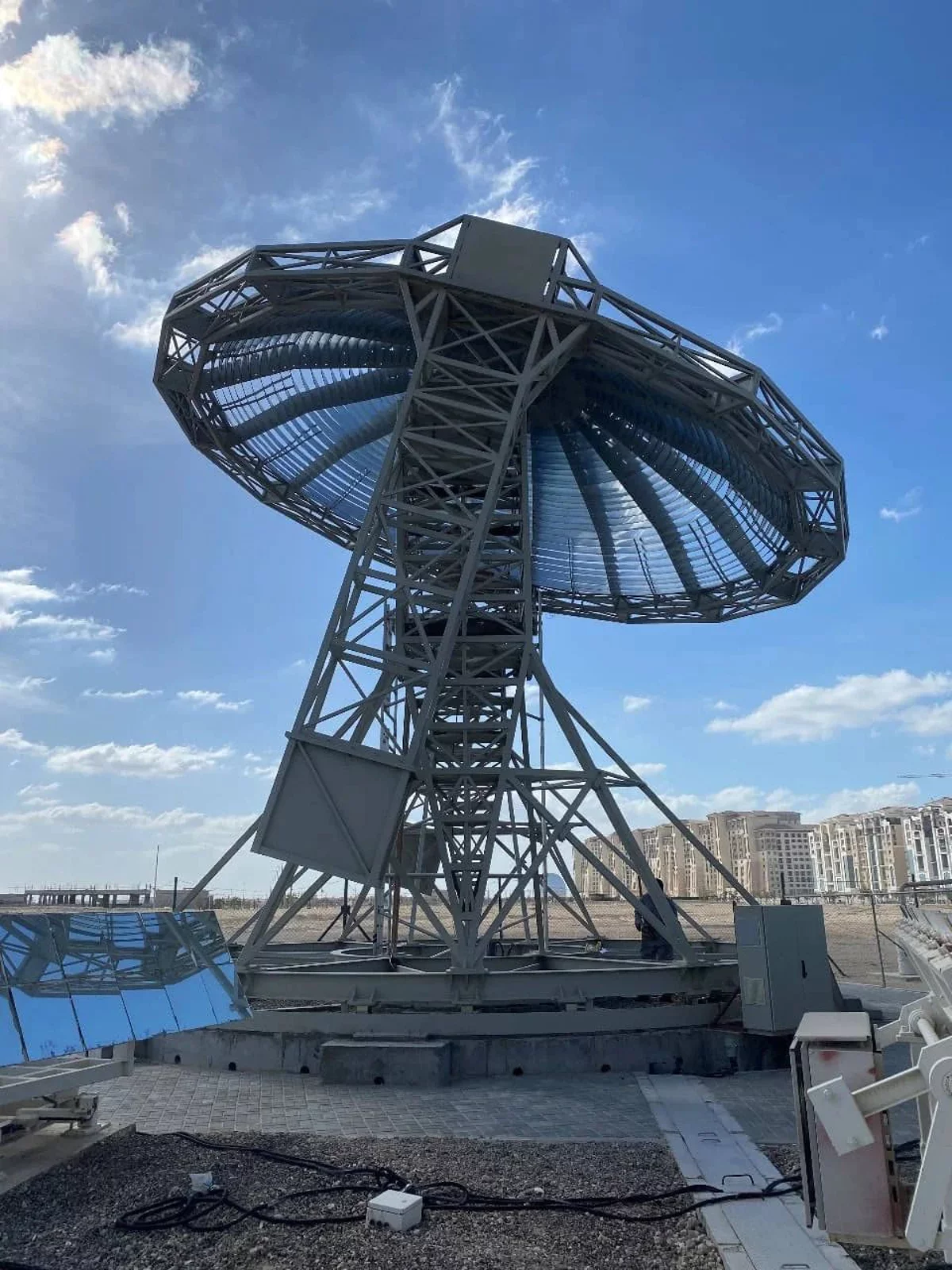
TechnologyClimatenza Solar represents a groundbreaking force in renewable energy technology,specializing in the revolutionary Ayman Solar Concentrator (ASC) technology that isredefining the landscape of concentrated solar thermal technology (CST).
The company in collaboration is Wahaj Solar LLC has developed what they term the"5th Generation of Solar Concentrators," offering unprecedented efficiency, versatility,and cost-effectiveness in solar thermal energy applications. Through comprehensivefeasibility studies and real-world implementations, Climatenza has demonstrated theASC technology's capability to deliver industrial-grade thermal energy solutions thatsignificantly outperform traditional solar technologies.The ASC technology combines the advantages of both photovoltaic (PV) andconventional concentrated solar power systems while eliminating their inherentlimitations. With the ability to achieve temperatures exceeding 1,200°C, ultra-highefficiency rates of 75-85% for solar-to-thermal conversion, and innovative storagesolutions enabling 24/7 operation, Climatenza Solar is positioning itself as a leader inthe industrial decarbonization movementCLIMATENZA SOLAR
Company Background and Mission
Climatenza Solar is a pioneering technology company focused on "decarbonising
industries" through innovative solar thermal solutions. Through this feasibility study,
Climatenza presents ASC technology developed by our partners Wahaj Solar and
named after the Creator name, Dr Ayman. Wahaj has gained international recognition
for its breakthrough ASC technology, receiving acknowledgment from prestigious
institutions including the Dubai Electricity and Water Authority (DEWA), which presented
a Certificate of Appreciation to Professor Ayman Al-Maaitah for his contributions to
renewable energy excellence.
Verified Impact Data Card
JSW Steel: Salem Plant
This project's impact data is structured for Scope 3 Category 15 (Investments) reporting. Verified emissions reductions can be attributed to investor portfolios under the GHG Protocol Corporate Value Chain standard.
CSRD alignment under ESRS E1 (Climate Change) is in preparation and will be available once the EU taxonomy technical screening criteria are finalised for this project category.
Decentralised physical infrastructure network integration
will provide real-time MRV telemetry for this project.
What is this card?
The Verified Impact Data Card summarises the key environmental and assurance metrics for this project. Data is pulled live from VCS assessments and on-chain commitments.
How to read the data
- Emissions Reduction — Estimated annual CO2e avoided or removed, derived from the project's VCS methodology and baseline scenario.
- Overall Score — Composite VCS readiness score (0–100%) covering additionality, permanence, leakage, and MRV quality.
- REC % — Alignment with Renewable Energy Certificate issuance criteria.
- EEC % — Alignment with Energy Efficiency Certificate criteria.
- Phase — Current stage in the project development lifecycle.
- DePIN Integrity — Data integrity score from decentralised sensor network (uptime, calibration, completeness).
Glossary
- VCS — Verified Carbon Standard (Verra), a leading carbon credit certification programme.
- tCO2e/yr — Tonnes of carbon dioxide equivalent per year.
- VVB — Validation/Verification Body, the independent auditor that reviews project claims.
- Evidence Tier — Classification of supporting evidence quality (e.g. Tier 1 = measured data, Tier 3 = default factors).
- Commitment Hash — Cryptographic hash of the assessment data committed to blockchain for tamper-proof audit trail.
- DePIN — Decentralised Physical Infrastructure Network, providing real-time sensor-based MRV data.
- Scope 3 Cat. 15 — GHG Protocol category covering financed emissions from investments.
- CSRD / ESRS E1 — EU Corporate Sustainability Reporting Directive, climate change disclosure standard.
- MRV — Measurement, Reporting, and Verification.
Share & Embed
Share this project card or embed it on your website.
Full embed functionality available in Phase 2.
Investment Calculator
Credits Simulator
EEC & REC Project Credits Simulator v2.4.0
REC Assumptions
Financial Projections
Investor Inputs (REC)
Per-Year Valuation — Today vs Forecast
Voluntary: REC (Med-Low)
Voluntary: EEC / Removal (Med-High)
Compliance: EU ETS
REC Projects & SDG Synergies
- SDG 7: More renewables displacing fossil power.
- SDG 13: Verified reductions, market signal for clean power.
- SDG 11: Cleaner air & resilient grids.
EEC Assumptions
Financial Projections
Investor Inputs (EEC)
Per-Year Valuation — Today vs Forecast
Voluntary: EEC / Removal (Med-High)
Compliance: EU ETS
EEC Projects & SDG Synergies
- SDG 9: Industrial modernisation, AI/dMRV.
- SDG 12: Resource efficiency & demand-side abatement.
- SDG 7: "First fuel" energy efficiency.
CCUS Assumptions VM0049 · Industrial CCS
Pricing: bilateral offtake $30–80/t · 45Q floor $60–85/t (US) · no liquid spot market
Financial Projections
Investor Inputs (CCUS)
Per-Year Valuation — Today vs Forecast
CCUS / Industrial CCS (VM0049)
Compliance: EU ETS
CCUS Projects & SDG Synergies
- SDG 9: Industrial innovation — point-source capture at cement, steel, refining facilities.
- SDG 13: Hard-to-abate sector decarbonisation; permanent geological storage.
- SDG 11: Cleaner industrial zones, reduced local air pollutants alongside CO₂.
VM0049 (Verra, June 2024): modular CCS methodology covering geological storage, CO₂ utilisation, and transport pathways. 45Q tax credit provides a $60–85/t USD policy floor in the US.
EV Fleet Assumptions VM0038 · Transport Electrification
Pricing: $2–5/t spot VCM · $6–10/t premium bilateral · CORSIA-eligible · 46.4% CAGR sector
Financial Projections
Investor Inputs (EV Fleet)
Per-Year Valuation — Today vs Forecast
EV Fleet Credits (VM0038)
Voluntary: REC (Med-Low)
EV Fleet Projects & SDG Synergies
- SDG 7: Clean transport powered by renewable electricity.
- SDG 11: Sustainable cities — reduced urban air pollution, quieter streets.
- SDG 13: Transport decarbonisation; CORSIA-aligned fleet credits.
VM0038 (Verra): telematics-verified VKT reduction, smart charging, baseline grid displacement. Transport credits are the fastest-growing VCM segment (46.4% CAGR). DePIN sensor networks add verifiability premium.
Feeds & Endpoints
Primary endpoint: /wp-json/tenza/v1/prices (Auto tries relative; falls back to https://tenza.one/wp-json/tenza/v1/prices).
Project data: /wp-json/wp/v2/tenza_project (loads meta: emissions, funding, scores, stage, tech type).
Venues: ICE (EUA), CME (GEO / N-GEO), EEX (GO); I-REC registry (regional indications); EEC modeled.
FX: ECB euro reference (cached daily).
Methodology
Forecast outlook: Conservative/Base/Optimistic scale the 2035 multiplier path and apply a sale-realisation haircut; small discount-rate nudge reflects risk.
REC pricing: V-REC/GO/I-REC converted to selected units (MWh or tCO₂e-eq via EF) and currency; tier factor applies to REC/EEC classes.
Financials: All internal calculations in the selected currency. Annual net flow = (credit revenue × (1−haircut) + optional savings) − O&M. KPIs: IRR (Newton-Raphson), NPV and discounted payback at your rate.
Currency handling: Capex, O&M and savings are all in the selected currency. Credit prices are converted from their native currency via ECB rates.
Standards & Registries
Primary standards: Verra (VCS) & Gold Standard. Tool is Verra-first but surfaces Gold Standard context where relevant.
Market intel: See AlliedOffsets (market/registry analytics) and Gold Standard Dashboard for reference data and methodologies.
Demo Data
When LIVE is unavailable or Demo is selected, seeded baselines are used for tickers and trends so charts never render blank. Badges above clearly show DEMO.
Project selector fetches live data from the WordPress REST API. If the API is unreachable, the selector is hidden and manual inputs remain fully functional.
FAQ
[]
VCS Readiness Assessment
Summary
The 2025CLIMATENZA SOLAR project demonstrates comprehensive technical documentation, robust monitoring plans, and clear GHG quantification methodology, indicating strong VCS compliance potential. However, stakeholder engagement, safeguards, and emission reduction verification details require further development to achieve full readiness.
Scores
Checklist
Section 1: Project Details 48%
| Item | Status | PDD | Notes |
|---|---|---|---|
| Physical Location | ● | 1.5 | Evidence is weak or non-specific. |
| Other Entities | ✗ | 1.9 | Evidence is missing. |
| Sectoral Scope(s) | ✗ | 1.4 | Evidence is missing. |
| Project Scale (Small/Large) | ● | 1.3 | Evidence is weak or non-specific. |
| Estimated GHG Reductions | ✗ | 1.7 | Evidence is missing. |
| Project Start Date | ✗ | 1.11 | Evidence is missing. |
| Crediting Period Type | ✗ | 1.12 | Evidence is missing. |
| Ownership and GHG Rights | ● | 1.15 | Evidence is weak or non-specific. |
| Other Certifications | ✗ | 1.16 | Evidence is missing. |
| Participation in Other GHG Programs | ✗ | 1.17 | Evidence is missing. |
Section 2: Safeguards & Stakeholder Engagement 33%
| Item | Status | PDD | Notes |
|---|---|---|---|
| Stakeholder Consultation Process | ✗ | 2.1 | Evidence is missing. |
| Stakeholder Feedback Summary | ✗ | 2.1 | Evidence is missing. |
| Grievance Redress Mechanism | ✗ | 2.2 | Evidence is weak or non-specific. |
| Social & Environmental Risk Assessments | ● | 2.4 | Evidence is weak or non-specific. |
| No Net Harm Assessment | ● | 2.4 | Evidence is weak or non-specific. |
| Respect for Human Rights & Equity | ✗ | 2.4 | Evidence is missing. |
| Worker and Labour Rights | ✗ | 2.4 | Evidence is missing. |
| Free, Prior, Informed Consent (FPIC) | ✗ | 2.4 | Evidence is missing. |
| Community Health and Safety | ● | 2.4 | Evidence is weak or non-specific. |
| Cultural Heritage Protection | ✗ | 2.4 | Evidence is missing. |
| Gender Equality Considerations | ✗ | 2.4 | Evidence is missing. |
| Indigenous Peoples Rights | ✗ | 2.4 | Evidence is missing. |
| Biodiversity Impact | ● | 2.4 | Evidence is weak or non-specific. |
| Water Resource Impact | ● | 2.4 | Evidence is weak or non-specific. |
Section 3: Methodology Application 87%
| Item | Status | PDD | Notes |
|---|---|---|---|
| Methodology Version | ● | 3.1 | Evidence is weak or non-specific. |
| Baseline Scenario Determination | ● | 3.4 | Evidence is weak or non-specific. |
| Regulatory Surplus | ● | 3.5.1 | Evidence is weak or non-specific. |
| Technological Barriers | ● | 3.5.2 | Evidence is weak or non-specific. |
| Common Practice Analysis | ● | 3.5.2 | Evidence is weak or non-specific. |
| Sensitivity Analysis | ● | 3.5.2 | Evidence is weak or non-specific. |
Section 4: GHG Quantification 62%
| Item | Status | PDD | Notes |
|---|---|---|---|
| Project Emissions Approach | ✗ | 4.3 | Evidence is weak or non-specific. |
| Leakage Emissions (tCO2e/yr) | ✗ | 4.4 | Evidence is weak or non-specific. |
| Leakage Assessment | ● | 4.4 | Evidence is weak or non-specific. |
| Calculation Spreadsheet/Tool | ● | 4.1 | Evidence is weak or non-specific. |
| Uncertainty Assessment | ✗ | 4.6 | Evidence is missing. |
| Ex-Post Monitored Parameters | ✗ | Table in 5.1 | Evidence is weak or non-specific. |
| GWP Values Source | ✗ | 4.1 | Evidence is missing. |
Section 5: Monitoring Plan 85%
| Item | Status | PDD | Notes |
|---|---|---|---|
| Record-Keeping & Archiving | ✗ | 5.3 | Evidence is missing. |
| Monitoring Roles & Responsibilities | ● | 5.4 | Evidence is weak or non-specific. |
| Emergency Procedures | ● | 5.5 | Evidence is weak or non-specific. |
Methodology
- VCS Methodology
- AMS-II.C
- Version
- v15.0
- Project Type
- Concentrated Solar Thermal (ASC technology) with direct superheated steam and feedwater preheat options
- Capacity
- 17.6 MW (peak thermal), 25.94 GWh/year (annual thermal energy)
- Baseline Scenario
- Current system with continuous 75 MW operation, fuel split 70% coal / 30% BFgas, heat rate ~10 GJ/MWh, no solar augmentation, and baseline fuel consumption of 6,570 TJ/y.
Ghg
Monitoring
The monitoring approach involves continuous data collection via control systems (DCS/SCADA) with automated logging, focusing on key parameters such as flow, temperature, pressure, and system status. Data verification is achieved through calibration, validation, and QA/QC procedures to ensure accuracy and reliability.
Action Plan
- Provide complete project location details including coordinates, address, and facility name
- Collect and document information for Other Entities
- Identify applicable VCS sectoral scope(s) from the official VCS Sectoral Scope list
- Strengthen documentation for Project Scale (Small/Large) with more specific details
- Calculate emissions using methodology-specified equations and credible emission factors