
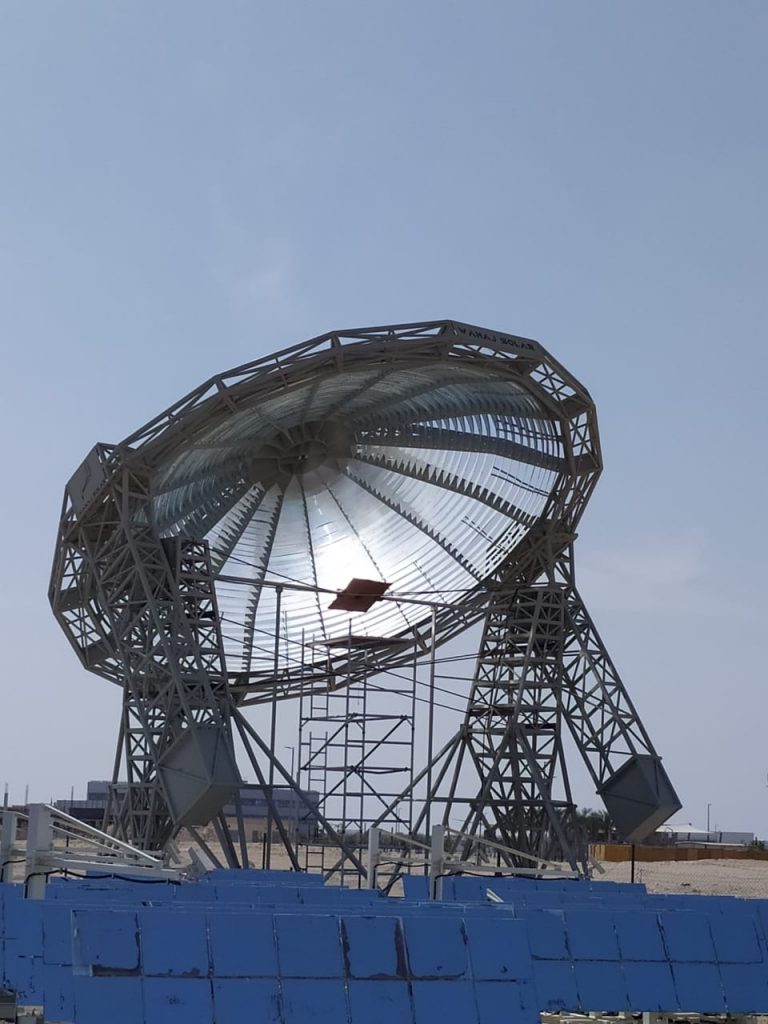
Climatenza – Tata Chemical


Climatenza – Tata Chemical
Offer Parameters & Calc Defaults set by the project owner — highlighted values drive the Finance Calculator
Project AI Research Agent
Project Story
Coming Soon
Verified Impact Data Card
Climatenza – Tata Chemical
This project's impact data is structured for Scope 3 Category 15 (Investments) reporting. Verified emissions reductions can be attributed to investor portfolios under the GHG Protocol Corporate Value Chain standard.
CSRD alignment under ESRS E1 (Climate Change) is in preparation and will be available once the EU taxonomy technical screening criteria are finalised for this project category.
Decentralised physical infrastructure network integration
will provide real-time MRV telemetry for this project.
Ask about this project's carbon methodology, Scope 3 reporting, DePIN integration, or emissions data.
What is this card?
The Verified Impact Data Card summarises the key environmental and assurance metrics for this project. Data is pulled live from VCS assessments and on-chain commitments.
How to read the data
- Emissions Reduction — Estimated annual CO2e avoided or removed, derived from the project's VCS methodology and baseline scenario.
- Overall Score — Composite VCS readiness score (0–100%) covering additionality, permanence, leakage, and MRV quality.
- REC % — Alignment with Renewable Energy Certificate issuance criteria.
- EEC % — Alignment with Energy Efficiency Certificate criteria.
- Phase — Current stage in the project development lifecycle.
- DePIN Integrity — Data integrity score from decentralised sensor network (uptime, calibration, completeness).
Glossary
- VCS — Verified Carbon Standard (Verra), a leading carbon credit certification programme.
- tCO2e/yr — Tonnes of carbon dioxide equivalent per year.
- VVB — Validation/Verification Body, the independent auditor that reviews project claims.
- Evidence Tier — Classification of supporting evidence quality (e.g. Tier 1 = measured data, Tier 3 = default factors).
- Commitment Hash — Cryptographic hash of the assessment data committed to blockchain for tamper-proof audit trail.
- DePIN — Decentralised Physical Infrastructure Network, providing real-time sensor-based MRV data.
- Scope 3 Cat. 15 — GHG Protocol category covering financed emissions from investments.
- CSRD / ESRS E1 — EU Corporate Sustainability Reporting Directive, climate change disclosure standard.
- MRV — Measurement, Reporting, and Verification.
Share & Embed
Share this project card or embed it on your website.
Full embed functionality available in Phase 2.
Investment Calculator
Credits Simulator
Project Credits Simulator v1.5.0
REC Assumptions
Financial Projections
Investor Inputs (REC)
Per-Year Valuation — Today vs Forecast
Voluntary: REC (Med-Low)
Voluntary: EEC / Removal (Med-High)
Compliance: EU ETS
REC Projects & SDG Synergies
- SDG 7: More renewables displacing fossil power.
- SDG 13: Verified reductions, market signal for clean power.
- SDG 11: Cleaner air & resilient grids.
EEC Assumptions
Financial Projections
Investor Inputs (EEC)
Per-Year Valuation — Today vs Forecast
Voluntary: EEC / Removal (Med-High)
Compliance: EU ETS
EEC Projects & SDG Synergies
- SDG 9: Industrial modernisation, AI/dMRV.
- SDG 12: Resource efficiency & demand-side abatement.
- SDG 7: "First fuel" energy efficiency.
CCUS Assumptions VM0049 · Industrial CCS
Pricing: bilateral offtake $30–80/t · 45Q floor $60–85/t (US) · no liquid spot market
Financial Projections
Investor Inputs (CCUS)
Per-Year Valuation — Today vs Forecast
CCUS / Industrial CCS (VM0049)
Compliance: EU ETS
CCUS Projects & SDG Synergies
- SDG 9: Industrial innovation — point-source capture at cement, steel, refining facilities.
- SDG 13: Hard-to-abate sector decarbonisation; permanent geological storage.
- SDG 11: Cleaner industrial zones, reduced local air pollutants alongside CO₂.
VM0049 (Verra, June 2024): modular CCS methodology covering geological storage, CO₂ utilisation, and transport pathways. 45Q tax credit provides a $60–85/t USD policy floor in the US.
Thermal Energy Storage Assumptions AMS-II.C · AMS-III.AE · ACM0014 (adj.)
Pricing: $6–9/t standard · $10–14/t IoT-verified · $14–18+/t DePIN data-anchored · TenzaHeat/Climatenza integrated stack
Financial Projections
Investor Inputs (TES)
Per-Year Valuation — Today vs Forecast
Thermal Energy Storage Credits
Voluntary: REC (Med-Low)
Thermal Energy Storage & SDG Synergies
- SDG 7: Affordable & Clean Energy — storing surplus renewable heat makes clean thermal energy dispatchable.
- SDG 9: Industry & Innovation — core to industrial-heat decarbonisation (cement, chemical, food processing).
- SDG 12: Responsible Consumption — reduces fossil-fuel boiler runtime through load-shifting.
AMS-II.C · AMS-III.AE · ACM0014 (adj.): metered charge/discharge cycles, round-trip efficiency, displaced fossil-fuel baseline. TES is a natural fit for TenzaHeat + Climatenza solar-thermal stacks — DePIN-native temperature, flow, and dispatch telemetry anchor the verifiability premium.
- 💧 Water Benefit Certificates (WBCs) — adjacent certificate class: Gold Standard water restoration / access / quality projects.
- ♨ Methane / Waste-to-Energy — 28–84× CO₂e multiplier; ACM0001 · AMS-III.H · AMS-III.D; DePIN gas-flow verification.
Battery / Grid Storage Assumptions Verra draft storage · CDM grid EF (emerging)
Pricing: $5–8/t standard · $8–11/t IoT-verified · $11–15+/t DePIN data-anchored · SOC + dispatch-timing telemetry required
Financial Projections
Investor Inputs (Battery)
Per-Year Valuation — Today vs Forecast
Battery / Grid Storage Credits
Voluntary: REC (Med-Low)
Battery / Grid Storage & SDG Synergies
- SDG 7: Affordable & Clean Energy — unlocks higher renewable grid penetration by time-shifting surplus generation.
- SDG 9: Industry & Innovation — emerging storage methodology; DePIN dispatch-timing telemetry solves peaker-avoidance attribution.
- SDG 12: Responsible Consumption — avoids marginal fossil-peaker dispatch; reduces curtailment of renewables.
- SDG 13: Climate Action — direct hourly attribution of avoided grid emissions.
Verra draft storage methodologies and CDM grid emission factor frameworks: baseline = hourly marginal emission factor; monitoring = per-cycle MWh in / out + SOC + round-trip efficiency. Emerging methodology scarcity + MRV-intensive verification justify the tier premium for DePIN-monitored projects.
- 💧 Water Benefit Certificates (WBCs) — adjacent certificate class.
- ♨ Methane / Waste-to-Energy — 28–84× CO₂e multiplier; DePIN gas-flow verification.
India Carbon Credit Trading Scheme CCTS · phased-live · first session mid-2026
India's Carbon Credit Trading Scheme (CCTS) is the country's new domestic compliance carbon market, operated under a three-body structure: MoEFCC notifies sector intensity targets (via the Environment Protection Act 1986), BEE administers the scheme + issues Carbon Credit Certificates (CCCs) + operates the registry, and CERC regulates trading on accredited power exchanges. The scheme covers 9 sectors, ~740 obligated entities, and ~700 Mt CO₂e — roughly 16% of India's emissions.
Covered sectors
Aluminium · Cement · Chlor-alkali · Paper & Pulp · Petrochemical · Petroleum Refinery · Textile (Iron & Steel and Fertiliser — notification status as of April 2026 unconfirmed). Power generation is NOT in Phase 1 — a notable gap.
Trading venues & settlement
Order-book trading on IEX / HPX / PXIL (all CERC-accredited). MCX is NOT accredited. Settlement in INR. Indicative price band ~₹800–1,200/t (no gazetted floor/ceiling yet). First trading session expected mid-2026.
Sources: ICAP ETS Map · BEE notifications (Oct 2025 / Jan 2026) · CERC accredited-venues list · IETA India CCTS Business Brief (July 2025).
CCC vs CCC-V vs EScert — what each is, who issues, who trades
Indian project developers have three routes. Which one fits depends on whether the host entity is CCTS-obligated, whether the buyer needs international claim credibility, and how much legacy-PAT exposure sits on the balance sheet.
CCC — Compliance INDIC
- Issued by: BEE against sector intensity target
- Traded on: IEX · HPX · PXIL (INR)
- Eligible: CCTS-obligated entity outperforming target
- Foreign claim value: ❌ Not without Article 6 corresponding adjustment
CCC-V — Voluntary LIVE
- Issued by: BEE voluntary mechanism (launched March 2025)
- Methodologies: 8 at v1 release
- Eligible: Non-obligated Indian project developers
- Alternative to: Verra / Gold Standard international voluntary
EScert — Legacy LEGACY
- Scheme: PAT (2012–2024), winding down
- Throughput: 1.5M of 3.8M ESCerts Cycle I traded (poor)
- Migration: Surplus convertible to CCC at a to-be-gazetted ratio
- Owner action: Track surplus for the conversion opportunity
A project cannot issue BOTH a VCU (international voluntary) AND a CCC (Indian compliance) from the same tCO₂e reduction — buyer-side claims would clash. When a host is CCTS-obligated, the tCO₂e must be attributed to either the compliance ledger or the voluntary ledger. TenzaOne's Scope 3 Export flags this automatically via its doubleCountingRisk field.
Quick Revenue Estimator today's-price only · no IRR/NPV yet
Today's-price projection only. Full IRR/NPV forecasting waits on post-launch price discovery. For richer per-project modelling today, use the REC / EEC / CCUS / TES / Battery tabs.
Estimated revenue
CCC fallback price is indicative pending first trading session (mid-2026). Admin can override via wp option update tenza_feed_price_ccc X. When the admin override is set, terminal + MID + this simulator all pick up the new value on next page load.
India CCTS & SDG Synergies
- SDG 13: Climate Action — domestic compliance cap mobilises ~700 Mt CO₂e of industrial abatement against sector intensity targets.
- SDG 9: Industry, Innovation & Infrastructure — 9 hard-to-abate sectors (cement / aluminium / chlor-alkali / petchem / steel / textile / refinery) directly incentivised to decarbonise.
- SDG 11: Sustainable Cities — supports cleaner industrial clusters and PM/NOx co-reductions alongside CO₂.
- SDG 7: (CCC-V track) — voluntary mechanism adds domestic route for clean-energy projects below compliance threshold.
TenzaOne positioning: dMRV is ACV-Agency-compatible and registry-complementary, NEVER a registry replacement. DePIN telemetry supplies underlying M&V evidence; ACV Agencies verify and sign; BEE issues. The blockchain anchor adds auditable provenance the ACV process can optionally cite. CCTS explicitly encourages dMRV as best practice even though it does not mandate it.
- Project to Credits — India CCTS tab → (full flow + CCTS-vs-VCM developer Q&A)
- Carbon Markets widget — India CCTS deep dive →
- DePIN stack → (how TenzaOne dMRV integrates)
Feeds & Endpoints
Primary endpoint: /wp-json/tenza/v1/prices (Auto tries relative; falls back to https://tenza.one/wp-json/tenza/v1/prices).
Project data: /wp-json/wp/v2/tenza_project (loads meta: emissions, funding, scores, stage, tech type).
Venues: ICE (EUA), CME (GEO / N-GEO), EEX (GO); I-REC registry (regional indications); EEC modeled.
FX: ECB euro reference (cached daily).
Methodology
Forecast outlook: Conservative/Base/Optimistic scale the 2035 multiplier path and apply a sale-realisation haircut; small discount-rate nudge reflects risk.
REC pricing: V-REC/GO/I-REC converted to selected units (MWh or tCO₂e-eq via EF) and currency; tier factor applies to REC/EEC classes.
Financials: All internal calculations in the selected currency. Annual net flow = (credit revenue × (1−haircut) + optional savings) − O&M. KPIs: IRR (Newton-Raphson), NPV and discounted payback at your rate.
Currency handling: Capex, O&M and savings are all in the selected currency. Credit prices are converted from their native currency via ECB rates.
Standards & Registries
Primary standards: Verra (VCS) & Gold Standard. Tool is Verra-first but surfaces Gold Standard context where relevant.
Market intel: See AlliedOffsets (market/registry analytics) and Gold Standard Dashboard for reference data and methodologies.
Demo Data
When LIVE is unavailable or Demo is selected, seeded baselines are used for tickers and trends so charts never render blank. Badges above clearly show DEMO.
Project selector fetches live data from the WordPress REST API. If the API is unreachable, the selector is hidden and manual inputs remain fully functional.
Status Updates
coming soon
VCS Readiness Assessment
Summary
Quick assessment complete. Found 6 of 10 core PDD fields. Preliminary readiness estimate: 24%. Note: Quick scores are estimates — run Full Assessment for accurate 76-point scoring.
Scores
Checklist
No checklist data available. Run a VCS assessment to generate checklist items.
Methodology
- VCS Methodology
- Not mentioned
- Capacity
- 30 MW renewable energy plant
- Baseline Scenario
- Reliance on natural gas and diesel for process heating
- Additionality Evidence
- Not mentioned
Ghg
Monitoring
Not mentioned
Safeguards
- Stakeholder Consultation
Not mentioned
- Grievance Mechanism
Not mentioned